Auction 1 - Rare Hebrew Books, Manuscripts & Rabbinic Letters
Lot 34:
Description
Italy, [probably 1741–1743?].
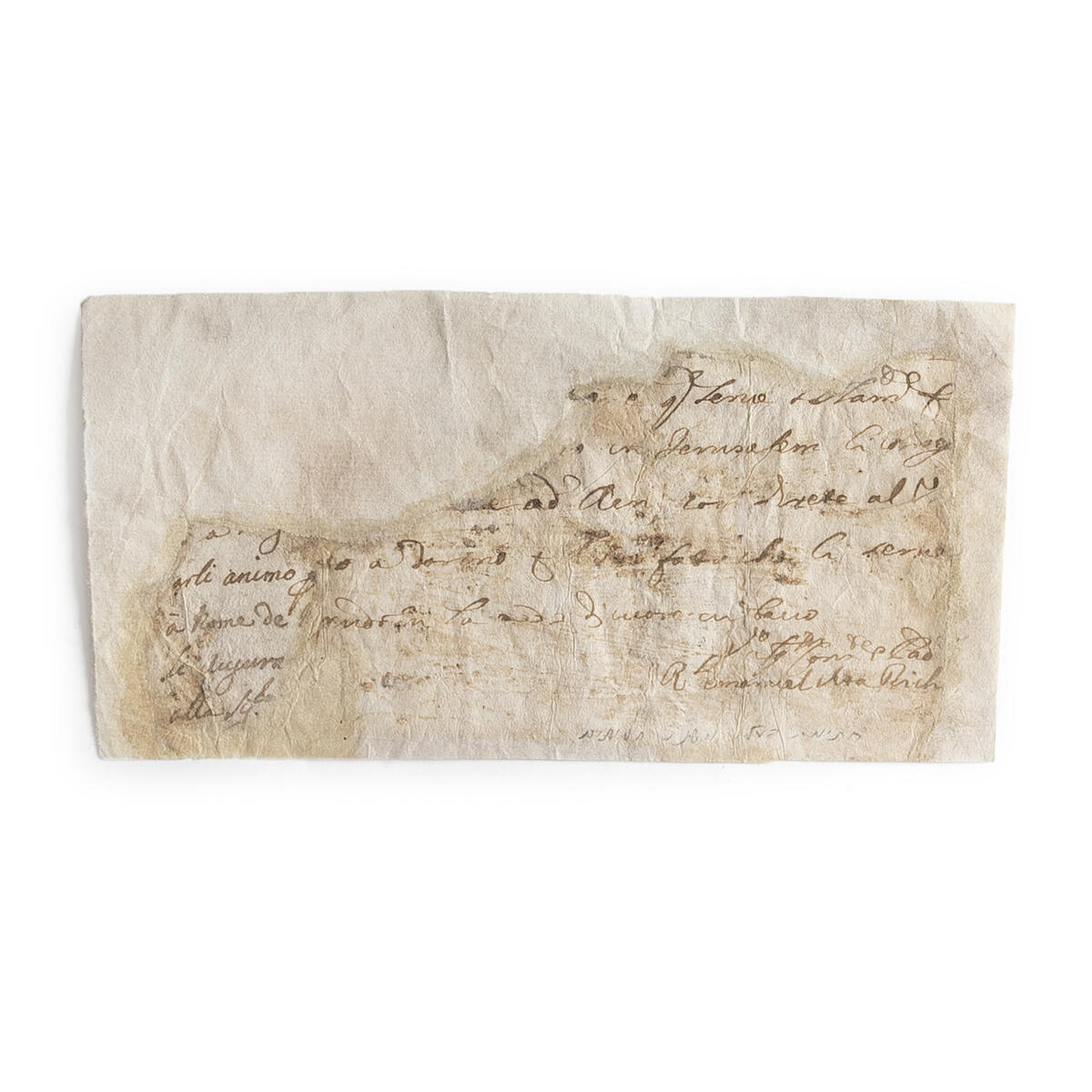
The surviving legacy of Rabbi Immanuel Ḥai Ricchi is almost entirely Hebrew. His printed works and manuscripts established him among the foremost kabbalists and rabbinic scholars of the eighteenth century, while his restless travels, from Ferrara and Rovigo through Gorizia, Venice, Safed, and ultimately Jerusalem, made him one of the era’s most remarkable rabbinic figures. Yet this document belongs to an altogether different world. Rather than a page of Torah scholarship, it appears to be an Italian legal or administrative instrument, written entirely in the vernacular and bearing Ricchi’s autograph in Roman letters, a striking survival from the everyday realities that lay beyond his Hebrew literary corpus.
The signature alone is of exceptional interest. Rather than rendering his name phonetically, Ricchi signs “R. Emanuele Vita Richi,” translating his Hebrew name חי into its Italian equivalent, Vita (“life”). This corresponds precisely to the form by which he habitually identified himself in Hebrew -עמנואל חי- while simultaneously adapting it for an Italian-speaking audience. Despite extensive published scholarship on Ricchi’s writings and biography, examples of his autograph in Latin script appear to be exceedingly uncommon, if not entirely unpublished. The present document thus offers a rare glimpse of the celebrated kabbalist operating as an Italian citizen navigating the documentary culture of his time.
Its historical setting only heightens the intrigue. Ricchi spent the final years of his life bound to the destiny of the Jewish community in Jerusalem. After settling there in 1737, he established a Beit Midrash (study house) that later became associated with the famed Kenesset Yisrael yeshivah, founded by the Ohr HaHaim HaKadosh, R. Haim ibn Attar. Four years later he returned to Italy in order to publish his writings and raise support for the Jerusalem institution, intending to return once his mission was complete. But, he never returned. In 1743, while traveling through northern Italy, he was murdered by soldiers who robbed him, leaving his body buried by the banks of the Reno River until members of the Jewish community recovered it days later for burial. Although the damaged text has not yet yielded a complete reading, the document’s Italian language, legal character, and autograph signature invite the tantalizing possibility that it belongs to this final chapter of Ricchi’s life, when correspondence, authorizations, financial declarations, and communal business formed the indispensable bridge between Jerusalem and the Jewish communities of Italy. Whether or not that connection can ultimately be proven, the document unmistakably captures the great mystic in one of the least expected settings: not at his writing desk composing kabbalistic treatises, but participating in the practical machinery of eighteenth-century Jewish life.
Single folio. Manuscript in an Italian cursive hand, signed at foot “R. Emanuel Vita Richi.” The text is written entirely in Italian. Portions of the document are obscured by staining and abrasion, though the autograph signature remains clear and well preserved.
Opening price: $6,000
Share this lot: