Auction 1 - Rare Hebrew Books, Manuscripts & Rabbinic Letters
Lot 35:
Description
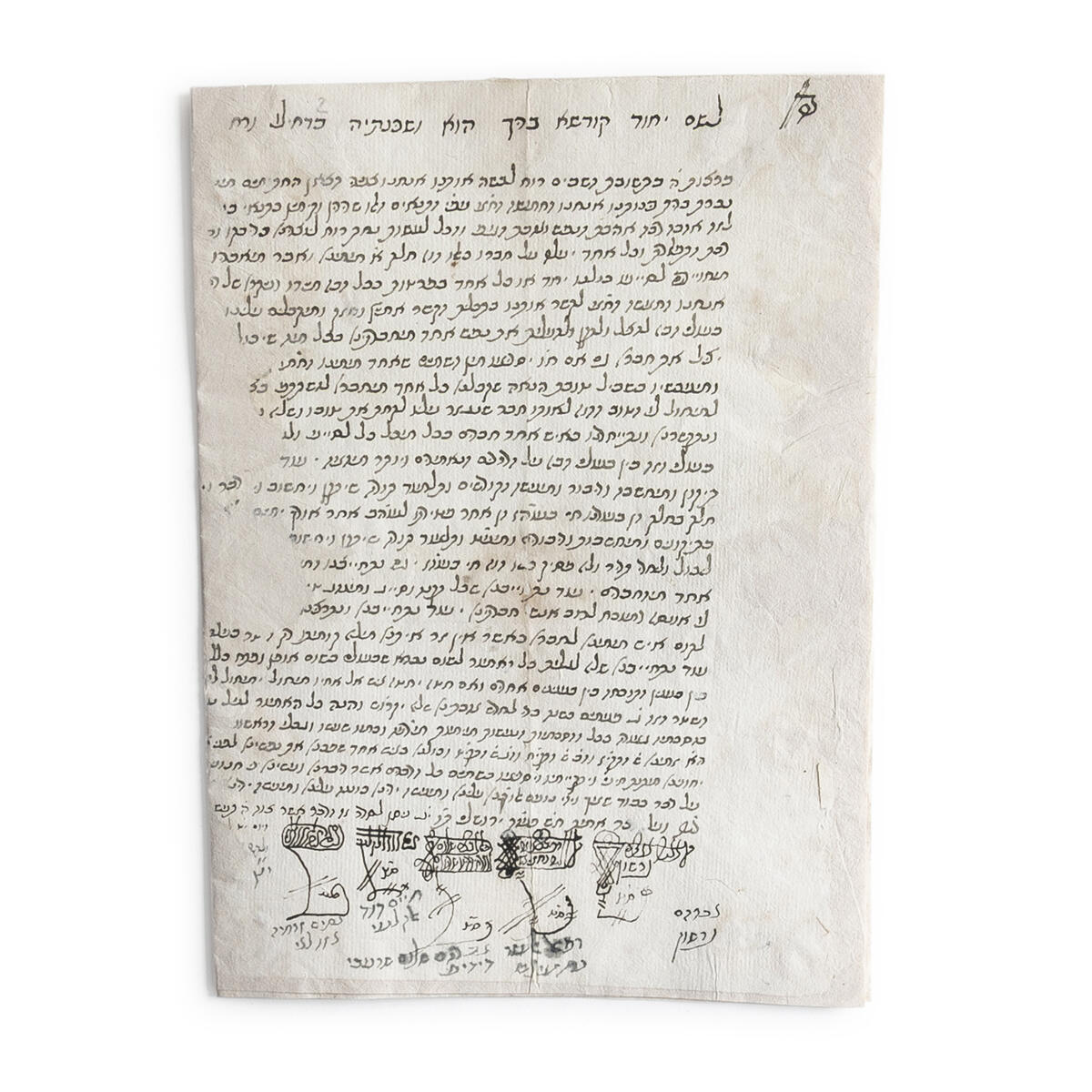
/ With the formal admission of an additional member, 1807
Some manuscripts preserve the ideas of great scholars. Others preserve the constitutions of forgotten worlds.
Before us lies the founding charter of a private fellowship of Jerusalem’s kabbalists. Carefully prepared in a handsome scribal hand, arranged in the formal style of a legal deed, and ultimately subscribed by six of the city’s leading mystics, this Shetar Hitkashrut (“Covenant of Fellowship”) records an extraordinary attempt to transform spiritual ideals into binding obligations. It was not enough, these men believed, to admire one another, study together, or strive for holiness as individuals. They sought something far more radical: to become, in their own words, “כאיש אחד חברים” – one man, united in fellowship.
Modern readers unknowingly encounter an echo of this world every day. Before beginning the morning prayers, many recite the brief declaration, “I hereby accept upon myself the commandment, ‘Love your fellow as yourself.'” Within the hidden circles of Jerusalem’s kabbalists, however, those words were not merely spoken, they were signed. The present covenant expands that single sentence into an entire way of life. Its members pledged to regard one another as limbs of a single body; to extinguish resentment before it could take root; to rebuke one another with love; to pray for one another in times of illness; and to renew their bond throughout the year lest, as the covenant itself memorably puts it, their love “grow cold.” More astonishing still, they declared that every prayer, every mitzvah, every page of Torah and every mystical tikkun performed by one member would belong equally to all. Even death would not dissolve the fellowship: the departed would continue to partake in the Torah and good deeds of their companions as though they still lived among them.
This was no isolated experiment. As demonstrated by Meir Benayahu, the document consciously revives the secret shtarei hitkashrut of eighteenth-century Yeshivat Bet El, preserving and adapting the constitutional language of the Rashash’s (R. Shalom Sharabi) circle nearly half a century later. It therefore offers a rare glimpse into the continuity of Jerusalem’s hidden kabbalistic societies, not merely their doctrines, but the practical mechanisms by which they preserved discipline, secrecy, mutual responsibility, and spiritual unity from one generation to the next.
The fellowship itself reads almost like a gathering of dynasties. Among the original signatories is Rabbi Raphael Abraham Shalom Mizrahi Sharabi, grandson and eventual successor of the Rashash at Yeshivat Bet El. Another is Rabbi Nissim Zerahiah Azulai, grandson of the Chida, later rabbi of Safed, who perished in the catastrophic earthquake of 1837. Three years later the fraternity formally admitted Rabbi Abraham Bekhor David by a separate act of kinyan; identified as a grandson of Rabbi Gershon Kitover, brother-in-law of the Baal Shem Tov and one of the earliest transmitters of Hasidism to the Holy Land. Within a single document converge the living heirs of the Rashash, the Chida, and Gershon Kitover – three lineages whose influence would shape the spiritual landscape of the Jewish world.
The manuscript itself vividly reflects its purpose. Rather than a collection of detached endorsements, the signatures gather beneath the covenant like the members of the fraternity itself, while the later admission remains visibly distinguishable from the original five, allowing the history of the brotherhood to be read directly from the page. Folded, preserved, and evidently treasured, the document is not simply evidence that such a fellowship once existed—it is the very charter by which six Jerusalem kabbalists sought to bind their souls together in this world and the next.
Autograph manuscript in a fine Hebrew cursive, Jerusalem, 1804. Two-column legal format. Signed by the five founding members, with the later autograph admission of Rabbi Abraham Bekhor David by formal kinyan (1807).
References: Benayahu, Asufot 9:95-98; Hallamish, Kabbalah (Israel 2002) 356ff.
Condition: very good condition
Opening price: $10,000
Share this lot: