Auction 1 - Rare Hebrew Books, Manuscripts & Rabbinic Letters
Lot 40:
Description
Damascus, early seventeenth century.
For more than four centuries, R. Chaim Vital, has stood at the gateway to the teachings of the Arizal. It was through his pen that the vast architecture of Lurianic Kabbalah was recorded, ordered and transmitted to the Jewish world. The present leaf opens a door onto a far more private chamber. Here, R. Chaim Vital appears at his desk as a collector of remedies, recipes, observations and practical traditions drawn from a striking range of sources.
The folio belongs to R. Chaim Vital’s remarkable autograph compendium now generally known as Sefer ha-Pe’ulot. Its original title is unknown. The beginning of the manuscript, including its introduction, has been lost, and the surviving autograph offers no indication that R. Chaim Vital himself assigned the collection a formal name. Later generations referred to it by various titles, including Ta’alumot Hokhmah, Sefer ha-Refu’ot, and Sefer ha-Segullot. The modern title, Sefer ha-Pe’ulot, reflects the language of the manuscript itself and the extraordinary range of operations gathered within its pages.
This was not a book written from beginning to end, but a working notebook that grew over many years. The surviving manuscript is carefully organized in its opening sections before giving way to increasingly miscellaneous collections of notes, recipes, observations, and practical instructions. Its index distinguishes between procedures personally tested, traditions received from trusted informants, operations reported as effective by others, and material copied from earlier books. The manuscript thus preserves with unusual immediacy his habits of collecting, evaluating and preserving practical knowledge.
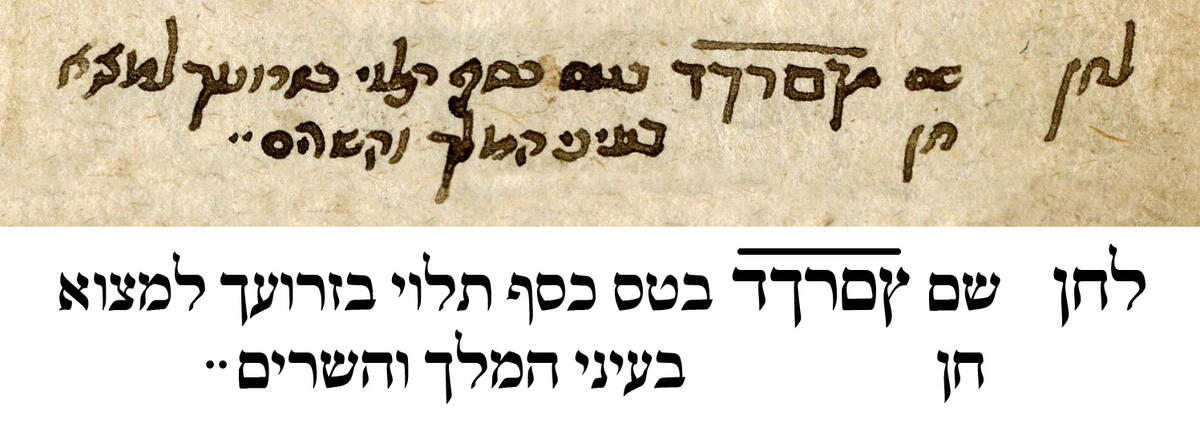
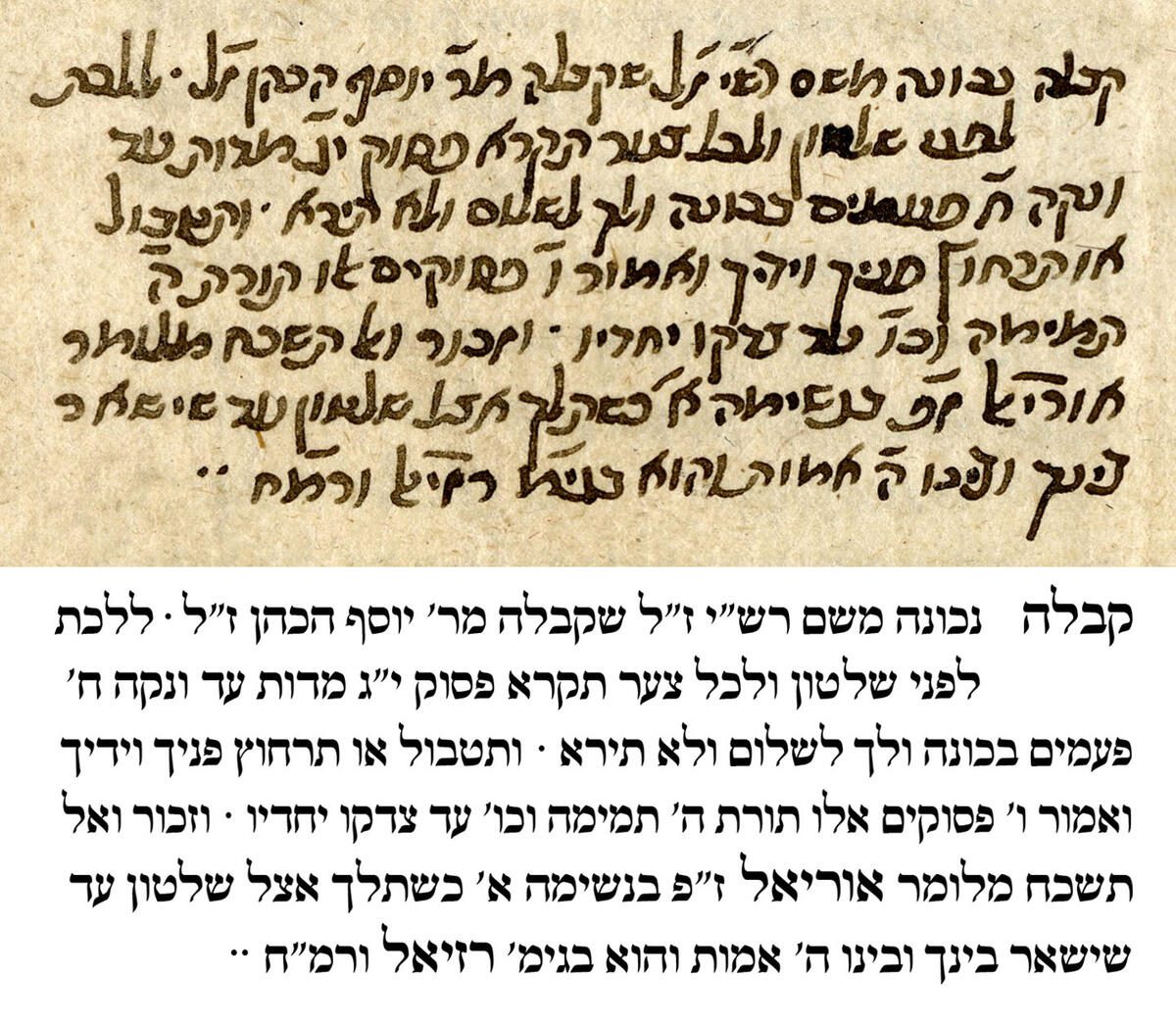
The present folio offers an especially vivid glimpse into that world. Its entries range from remedies for mental illness to procedures for expelling a possessing spirit, methods for restoring harmony between husband and wife, and techniques for acquiring chen, grace or favor. Other passages prescribe divine names to be inscribed upon parchment, combinations of letters to be carried upon the body, or formulae to be recited for specific purposes. Dense columns of closely written text are interrupted by carefully arranged configurations of sacred names and letter combinations forming part of the prescribed operations.
Medicine, natural philosophy, chemistry, astrology, segullot, and practical Kabbalah repeatedly appear alongside one another in Sefer ha-Pe’ulot. Herbs, minerals and bodily ailments share its pages with sacred verses, divine names and practical kabbalistic procedures. Some knowledge came from books, some from physicians and craftsmen, some from kabbalists and trusted acquaintances, while certain procedures are explicitly recorded as having been personally tested. Together, the entries preserve an unusually intimate record of the medical, technical, religious and practical knowledge gathered by R. Chaim Vital in the Ottoman East.
The extraordinary combination of medical, chemical, technological, magical and domestic recipes has invited comparison with the early modern genre sometimes known as “books of secrets,” compilations in which diverse forms of practical and arcane knowledge were gathered together. The comparison, however, is not exact. Unlike European books of secrets associated particularly with print and wider dissemination, Sefer ha-Pe’ulot remained in manuscript and appears to have been intended for restricted circulation, perhaps originally for private use.
More significantly, the juxtaposition of medicine and Kabbalah in these pages need not be understood as the accidental meeting of two unrelated interests. It has been argued that R. Chaim Vital’s medical and practical writings should not be sharply separated from his kabbalistic corpus. Comparison of Sefer ha-Pe’ulot with his explicitly Lurianic writings has revealed important continuities in their practical orientation and in the use of medical patterns of diagnosis, treatment and prescribed action. Medical discourse has accordingly been shown to provide an important framework for understanding aspects of Lurianic practice and tikkun. The manuscript thus offers evidence not only for R. Chaim Vital’s activities as a healer and collector of practical knowledge, but for an intellectual world in which medical and kabbalistic modes of thought could be closely related.
The autograph originally comprised approximately 124 folios. After R. Chaim Vital’s passing, the manuscript came into the possession of his son, R. Shmuel Vital, who preserved it, prepared an extensive index, and added editorial matter. A later addition was made by his grandson, R. Moshe Vital. The present leaf belongs to the original autograph nucleus of the manuscript and preserves R. Chaim Vital’s own handwriting.
The manuscript appears to have accumulated over an extended period. Changes in handwriting reveal successive stages of composition, suggesting that R. Chaim Vital returned to it repeatedly, adding new material as he continued to collect observations, recipes, remedies, and traditions. Its later portions have been associated with his final years in Damascus.
Few surviving manuscripts permit so direct an encounter with the daily intellectual life of R. Chaim Vital. The manuscript brings the reader unusually close to the working desk of one of the most influential figures in the history of Jewish mysticism.
Autograph folio, written recto and verso in two dense columns in the characteristic Sephardic cursive hand of R. Chaim Vital. With headings, marginal annotations, and diagrammatic arrangements of sacred names and letter combinations.
Reference: Sefer ha-Pe’ulot (Jerusalem, 2014) introduction; Avivi, Ohel Shem, (Jerusalem 1992) 191-192; Buchman, Pinkas ha-Mirshamim, Cathedra 99 (2001); Amar & Buchman, Practical medicine of Rabbi Hayyim Vital (Israel 2006); Bos, Hayyim Vital’s ‘Practical Kabbalah and Alchemy’ 55; Tamari, God as Patient (Jerusalem 2023) 58ff.
Condition: very good. Preserved in an elaborate custom binding.
Opening price: $48,000
Share this lot: